

Understanding University Applications
How to Apply to University
Application Process
Applying to university as an international student involves much more than simply submitting an application. From understanding the differences between applying directly to a university or through an education agent, to preparing personal statements, academic documents, and English language requirements, each stage plays an important role in securing admission. This guide also explains key parts of the admissions process, including conditional and unconditional offers, Confirmation of Acceptance for Studies (CAS), and the steps required before progressing to a student visa application. Designed to help students navigate the process confidently, the guide provides practical insights to support informed academic and financial decisions.
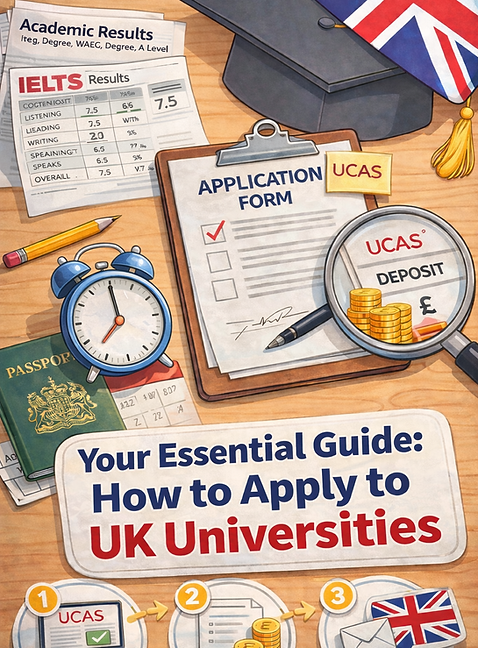
How to Apply
Understanding the different ways to apply to UK universities is an important part of the admissions process. This section provides a concise overview of applying directly to universities, applying through UCAS, and using education agents, helping international students understand the advantages, processes, and key considerations of each route

Application Process
How to Apply Directly - Postgraduate Courses
Many UK universities handle their own postgraduate applications and you can often apply directly through their website. You can check the course information for instructions on how to apply.
To register and apply for postgraduate courses, you will need to provide:
• Your personal details including your qualifications.
• A reference or contact details for a referee (someone, such as a lecturer or tutor, who can confirm your ability to do the course)
• A personal statement – where you explain why you want to do this course – and the skills, life experiences and achievements that make you suitable.
• Different postgraduate courses in the UK have different entry requirements, so check the individual course websites for instructions on how to apply.
Many postgraduate courses do not have a fixed application deadline, so you can apply as soon as you decide that you want to study on a UK course. However, it is always best to apply early to make sure you have the best chance of being accepted.
How to Apply Directly - Undergraduates Courses
Applying for an undergraduate degree in the UK is very simple. You don’t need to get in touch with lots of universities - you can apply for up to five courses at once through the Universities and Colleges Admissions Service (UCAS) for a small administration fee and UCAS handles everything else. Here’s how it works: 1. Register with UCAS First, go to the UCAS website where you can fill in your application form. Then write your personal statement. This is your chance to stand out from the crowd by explaining why you are interested in the course, the skills you have that make you suitable, and your life experiences and achievements. You also need to include a written reference from someone who can confirm your ability to do the course, such as a tutor or one of your school teachers. Make sure you contact your referees early so they have enough time to write this for you. To find out more click here: How to apply - undergraduate | Study UK
How to Apply - Applying through an Agent
Choosing an international study destination is one of the most important decisions you can make. Your family and friends may be able to help but making a final choice and applying to an education provider can be daunting. This is why many students get help from an education agent or counsellor. Read the full student and parent guide to choosing an education agent. Why use an education agent Education agents and counsellors can support you throughout the process of applying to study in the UK. After working with you to understand your course options and visa requirements, an agent can help you identify and apply to education providers. If you receive multiple offers, an agent can then help you evaluate them and provide further guidance on admission deadlines. Once you have made your decision and have started to prepare to come and study in the UK, many agents will help you gather and submit the documents you need for your visa. What do I need to consider? All agents and counsellors supporting students to study in the UK should have completed the British Council UK certified counsellor training, which provides them with appropriate knowledge and awareness of the UK as a study destination. They should also have committed to the national code of ethical practice for UK education agents, which sets out the behaviours and values that agents and counsellors are expected to adhere to.
After you apply
Acknowledging your application After your application is received, an applicant record will be created for you. When this is ready you will receive an email containing your applicant details and choice numbers. You should normally receive this email within two working days. Your application will then be sent for academic consideration. You can check the progress of your application at any time simply by logging back into your online application. Waiting for a decision For most taught courses, it normally takes us around four weeks to receive a decision on applications. It can take longer at busy times. For some courses, you may be invited to attend an interview with staff from your academic school. You can find information on what to expect in an interview on the university website. When a decision has been made When a decision has been made, it will appear in your online application. You will also receive an email to confirm this. If you have been offered a study place, you will be provided with an official PDF offer letter detailing any conditions and the tuition fees. The offer letter will be attached to our email and also available for you to download from your online application. If you have not been offered a study place and you would like feedback on this decision, you should contact the academic school / university directly in writing. You can find their contact details under the relevant entry in the postgraduate course listings.
Receiving an Offer - Conditional Offer
Receiving a conditional offer is a key stage in the university admissions process for many international students. This section explains how to accept offers, understand common offer conditions such as English language requirements (IELTS), academic requirements, and tuition deposit conditions, as well as the steps involved in successfully meeting these conditions before progressing to CAS issuance and visa application stages.

Meeting the University's Conditions
Conditional Offers
A Conditional offer means that there are academic and other non-academic entry requirements that you need to meet before you can start the course, for example a certain English language score or a minimum grade in your current studies.
If we've made you a Conditional offer, the conditions will be stated in your offer letter.
Your offer will be conditional if we need verification of your qualifications, or if you have to meet other non-academic entry requirements.
The offer letter will state the qualification(s) you must provide and the results you must achieve, plus any non-academic requirements. All conditions must be met in full before you will be able to register for your programme.
The standard deadlines for meeting the conditions of your offer are provided on our key dates and deadlines page. A few courses use different deadlines. If this is the case for your course, it will be indicated in your offer letter.
If you have any problems attaching documents to your online application, please contact us.
When you've met these conditions, you should upload to your online application documents that prove it. When you've met all the conditions of your offer, we'll provide you with a new, Unconditional offer letter.
Accepting your offer
To accept and secure your place, you must respond to your offer by the date stated in your offer letter. This deadline refers to your acceptance of the offer, not the fulfilment of conditions. To respond to the offer, click on the ‘Respond to Offer’ link within your applicant portal.
Offer Conditions
ACADEMIC CONDITION: If your offer is conditional upon obtaining a degree (or other qualifications), the offer letter will state the level required. When your degree results are known, you will need to upload a copy of your degree certificate (or other qualifications) and final transcript once these are available. One of these must confirm that the degree has been awarded and state your overall grade. Please note that unofficial transcripts and screenshots are not acceptable. ENGLISH LANGUAGE CONDITION: If your native language is not English, your offer will be conditional upon obtaining a recognised English language qualification at a specified level, as detailed in your offer letter. Visit our website for more information on English language requirements. Meeting English language requirements You may ned show that you meet our English language requirements. For most courses, you don’t need to do this until you’ve been made an offer. Get more information about our English language requirements. IELTS stands for the International English Language Testing System – an English Language proficiency test. Globally, there are more than 4 million test takers a year, making IELTS the world’s most popular English language proficiency test for higher education and global migration. IELTS is developed and run by the British Council in partnership with IDP Education and Cambridge Assessment English. How does IELTS help with visa requirements? Immigration authorities in many English-speaking countries ask for proof of English language proficiency as a condition for being granted a visa. IELTS provides this proof. 1.After completing an IELTS test, you will receive an official Test Report Form (TRF) that contains your IELTS score. 2.Your TRF is valid for two years and should be submitted to visa authorities to prove your English proficiency. 3.Each University has its own IELTS score requirements. It’s important that you confirm what score you need to secure your offer. DEPOSIT CONDITION If you're an International applicant, we'll normally ask you to pay a deposit on your tuition fee after you accept an Unconditional offer. For some of our more popular courses, we'll ask you to pay when you accept a Conditional offer and we set a deadline for payment. We'll tell you more about this, including how you can pay and if there's a deadline, in your offer letter. If you are required to pay a deposit, this will be clearly stated as a condition in your offer letter along with a deadline to pay your deposit. Options to pay your deposit can be found in your applicant portal. The deposit payment will be deducted from the tuition fee at registration. PASSPORT INFORMATION If you are an international student you are required to upload a copy of your passport personal details page on your applicant portal. This should be the passport you intend to use to apply for your visa and travelling to the UK with. ATAS CERTIFICATE You will need an ATAS certificate to do certain types of study and research in the UK. If you need an ATAS certificate, you will usually get a statement with your offer letter confirming that you need ATAS and telling you what to do next. Without this certificate, your visa application will be refused. To apply for ATAS you need a statement from the University confirming the subject of your research or study. This is usually sent with your offer letter. If you don't have this statement, but need an ATAS certificate, please contact the Admissions Office. Once you have your statement you can make your ATAS certificate application online to the Foreign Commonwealth Office (FCO). This should take no longer than 30 minutes to complete. DISCLOSURE AND BARRING SERVICE (DBS) CHECKS Some programmes (e.g. PGCE/Teacher Training, Nursing, Midwifery, Social Work, and Healthcare Sciences) require a DBS check (formerly Criminal Records Bureau (CRB) checks), and your offer letter will clearly state if this is a condition of your offer. DECLARATION OF HEALTH Some programmes require you to complete a health declaration. Your offer letter will clearly state if this is required and will provide additional information accordingly.
Recieving an Offer - Unconditional Offer - CAS
This section explains unconditional offers and what they mean for international students who have successfully met their university admission requirements. It also provides an overview of the Confirmation of Acceptance for Studies (CAS), its importance in the student visa process, and the steps students must take before applying for their visa.

Unconditional Offer
Unconditional offers - Confirmation of Acceptance for Studies (CAS)
An unconditional offer means you have already met all the academic and non-academic requirements for entry.
You do not need to meet further conditions and can simply accept your offer. You will then be able to apply for accommodation and prepare for your studies.
Once you have accepted your offer and met all conditions, an unconditional acceptance letter will be issued via your applicant portal.
If you are an international applicant, you will be sent a Confirmation of Acceptance for Studies (CAS) statement, no earlier than six months before the start of your programme. The CAS statement will include your CAS number which you will require to apply for your visa to study in the UK.